March 30, 2022 | Jonathan Bird
“Well-managed industrial companies do not, as a rule, distribute to the shareholders the whole of their earned profits,” wrote John Maynard Keynes, one of the foremost economists of the twentieth century. “In good years, if not in all years, they retain a part of their profits and put them back into the business. Thus there is an element of compound interest operating in favor of a sound industrial development.” Keynes is not referring to reinvesting dividends—an activity that puts a tax liability on shareholders. He’s referring to retained profits, money earned by the company and retained in the company—an activity that does not put any tax liability on shareholders.
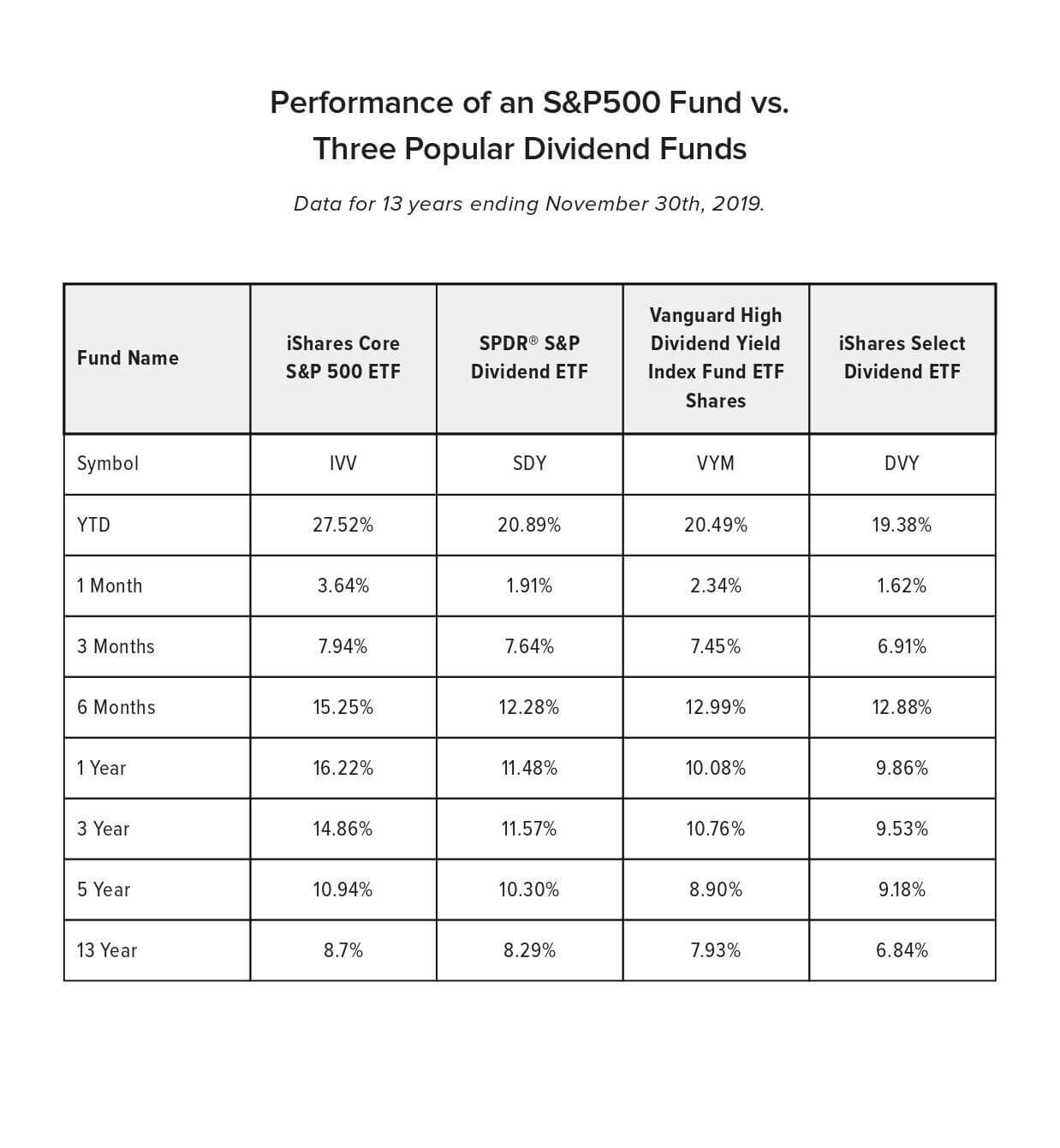
The numbers support what strikes me as common sense. Consider the accompanying chart. If you had invested $100,000 in a low-cost S&P 500 ETF fund—an approximation of the overall market—in 2007, you’d have had nearly $296,000 by November of 2019. If you’d put the same sum in one of the three popular dividend-based funds, you’d have as much as $60,000 less. Remember, you’re not losing out on dividends altogether when you invest in the overall market. The point is that an index fund has the potential to offer better total return—how much you receive in income plus price appreciation. The table below illustrates the returns of a low-cost S&P 500 index fund versus three popular dividend ETFs. Each column represents a fund, and the return figures below it represent the performance over a specific time period.