

April 1, 2022 | Jonathan Bird
In December of 2007, Warren Buffett placed a million-dollar wager with Protégé Partners, a hedge fund investment firm. It was a classic hare versus tortoise showdown. Buffett bet on the tortoise, wagering that an S&P 500 index fund would outperform whatever five hedge funds Protégé Partners picked over a ten-year period. The winner would make a dramatic public point, and the money would go to charity.
Buffett acknowledged that Protégé Partners had the look of a winning hare. “This assembly is an elite crew loaded with brains, adrenaline, and confidence,” he wrote. Still, Buffett believed that the tortoise—a virtually cost-free, unmanaged S&P 500 index fund—would win the race. And that was something Buffett wanted everyone with money in the stock market to know.
“Addressing this question is of enormous importance,” he wrote to the shareholders of Berkshire in 2017, at the conclusion of the race. “American investors pay staggering sums annually to advisors, often incurring several layers of consequential costs. In the aggregate, do these investors get their money’s worth? Indeed, in the aggregate, do investors get anything for their outlays?”
The outcome of the race wasn’t close: Buffett and his tortoise took the prize. In the first year, 2008, the hedge funds outperformed the index fund. Fast off the starting line! But in each of the next nine years, the index fund prevailed. Its annual average gain was 8.5 percent; the best of the five hedge funds checked in at 6.5 percent, and the worst at 0.3 percent.
By 2017, the money Buffett and Protégé Partners laid on the table had grown well beyond a million dollars. The beneficiary: Buffett’s charity of choice, Girls Inc. of Omaha, with its $2.2 million windfall.
So Buffett bet on the market itself, not on the ability of very smart people to pick a handful of winners from the crowd. What’s more, hedge fund managers charge fees, big fees – typically 2 percent of your principal plus 20 percent of your annual profits. That tips the odds even further in favor of the index-fund-tortoise.
Still not convinced? Look at the long term record of professional managers against the S&P 500 as measured byStandard and Poor’s. Over the past 15 years, 9 out of 10 funds have underperformed.
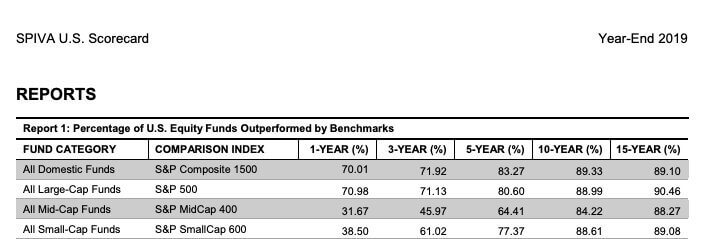
No wonder investors are moving into passive funds in record numbers, according to the WSJ.